

Sector Update / Consumer / Click here for full PDF version
Author(s): Andrianto Saputra ; Nicholas Bryan
- We expect staples margin to start to improve in 4Q26F amid lower Brent oil price and c.3 months inventory days.
- Given lower Brent oil, our economist expects non-subsidized fuel price to decline on Jul26 which may eventually result in SSSG improvement.
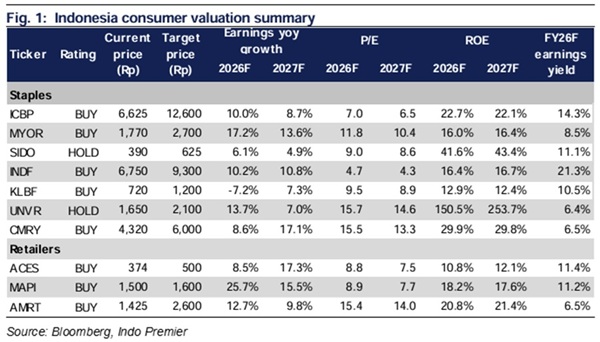
- We prefer on staples over retailers with , and as our top picks.
The reversal in Brent oil price start to impact staples GPM in 4Q26F
Brent oil prices have dropped significantly by -11% following expectations of US-Iran peace agreement scheduled to be signed on 19th Jun26. As such, we expect Brent linked raw material prices (packaging materials and API) to trend lower. Given average inventory days of c.3 months across our coverage, we expect GPM pressure to persist through 3Q26F with benefits of lower input costs may begin to materialize in 4Q26F.
/UNVR are the key beneficiary from the reversal in Brent oil price
In terms of raw materials, we note that combined packaging and Active Pharmaceutical Ingredients (API) costs account for 65/27/20/6/3% of total raw material costs for /UNVR/CMRY/MYOR/ICBP's. Hence, /UNVR are expected to be the key beneficiaries of the reversal in these input costs. Our sensitivity analysis shows that every 5% decline in packaging and API costs could increase FY27F earnings by 4.5/4.4/2.1/1.6/0.4% for /UNVR/CMRY/MYOR/ICBP, respectively.
SSSG may recover on the back of lower non-subsidized fuel prices
We note that non-subsidized fuel (Pertamax) price hike have had a negative impact on retailers' SSSG (Fig. 3-6) - (link to report). Given the recent decline in Brent oil price, our economist sees a possibility for Pertamax prices to drop in Jul26, assuming the US-Iran peace agreement is finalized on 19th Jun26. We view this could provide a positive boost to retailers' SSSG . In addition, lower Brent oil price may also reduce cost of imported goods, including plastic material of which increased its ASP by 10-15% to mitigate the GPM pressure. While suppliers have not yet announced price reductions, expects a lag of 2-3 months before lower input costs are reflected in procurement prices. As such, we estimate GPM to improve in 4Q26F.
Preference staples over retailers
We expect lower Brent oil prices could serve as a tailwind for consumer companies, particularly staples players, given the potential room for GPM expansion driven by lower packaging and raw material costs. While retailers may also benefit from improved consumer purchasing power, the earnings impact is likely to be less meaningful and may materialize with a longer lag. In terms of valuation, staples and retailers' stocks are trading at depressed valuation with FY26F PE of 9.5x (-2.4 s.d. from its 5yr avg) and 11.2x (-2.0 s.d. from its 5yr avg), suggesting a limited downside for the sector given a better oil price development. We continue to prefer staples over retailers with , and as our top picks. Risks to our call: cancellation of US-Iran peace deal, further USD/IDR appreciation, and weaker-than-expected purchasing power.
Sumber : IPS